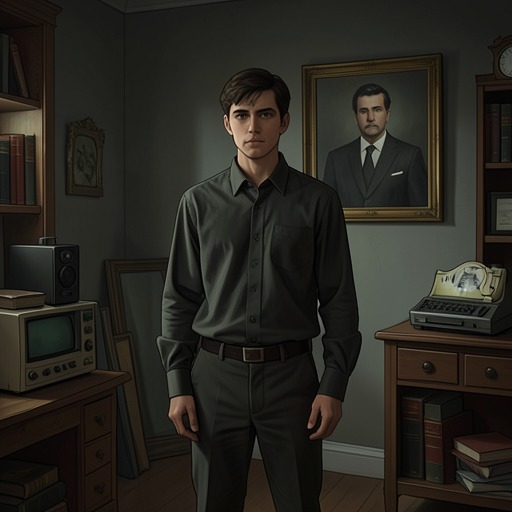
Death of Romain Gary’s father
Promise at DawnThe death of Romain Gary’s father, first understood as a killing in a gas chamber and later revealed as a fatal collapse just before he reached one, became a belated turning point in the narrator’s relationship to the father he had barely known. The letter that corrected the story did not lessen the horror: it made the father’s final moments newly immediate, and gave their estranged connection a meaning it had not possessed in life.
Estrangement and the First Account
The father had left soon after Romain Gary was born. At home, mentioning him brought a quick glance between his mother and Aniela, followed by a change of subject. The child concluded that the matter was painful or embarrassing and learned not to ask. He knew the man who had given him his name had another wife and children, traveled widely, and had gone to America; they met several times. The father seemed kind, but also uneasy and sad, and his gentle, apparently reproachful look left the boy feeling guilty without knowing why.
The narrator later believed that his father had died during the war in a German gas chamber, murdered as a Jew alongside his wife and two children, whom he believed to have been fifteen and sixteen. That account placed the father among the victims of an exterminatory violence that had also taken his family. Yet the narrator knew little about him, and the death remained part of a family history marked by silence rather than shared memory.
The Letter and the Corrected Circumstances
In 1958, after coming from Bolivia, where he was in charge of the French Embassy, to Paris to receive the Prix Goncourt for The Roots of Heaven, Romain Gary received a letter among the many sent on the occasion. Its writer had witnessed the father’s final moments while working as a doorman or receptionist at the place of execution; the narrator could not identify the man’s precise official title. According to this eyewitness, the father did not die inside the gas chamber. On the way to execution, only a few yards from its entrance, he fell dead from a heart attack brought on by fright.
The correspondent appears to have offered the information as consolation: the father, he thought, had been spared the gas chamber. But the correction did not make the death reassuring. It moved the father’s death from the chamber’s interior to the short distance before its entrance, where terror itself had stopped him. The account remained an eyewitness’s report, conveyed to the son years after the event, rather than something the narrator had seen or could independently confirm.
Reception and Significance
After reading the letter, Romain Gary sat for a long time holding it, feeling nothing and experiencing an entirely empty head. He put it in his pocket, went out to the staircase of the N.R.F. publishing house, where he had collected his mail, and leaned against the banister. The scene sets the private revelation against the public signs of his success and service: clothes made in London, his title as Chargé d’Affaires of France, the Cross of the Liberation, the rosette of the Legion of Honor, and the Prix Goncourt. Those distinctions did not provide a response to the news; the narrator could only stand still with the letter in his pocket.
Albert Camus, passing by and seeing that he was unwell, took him into his office. The father, previously little more than a stranger to his son, became his father on that day—not through renewed contact or a recovered family life, but through the belated knowledge of how he had died. The narrator’s wish that the man be known as his father makes the revelation an act of recognition as well as a report of death: the letter gives him a final, terrible circumstance through which to claim a relationship that had remained largely unspoken.